
Research Highlights
| Corresponding Author | 郭祺筠 | Title | Resolving the paradox of local warning signal diversity: A framework for hypothesis testing |
| Authors | Chi-Yun Kuo*, Shu-Ping Tseng | Publication Date | 2026.7.1 |
| Citation | 40(7), 1950–1959 | Journal | Functional Ecology |
| Impact Factor (2026) | 5.5 | DOI | 10.1111/1365-2435.70356 |
| WOS/PMID | WOS:001771779100001 |
Resolving the paradox of local warning signal diversity: A framework for hypothesis testing
Chi-Yun Kuo*, Shu-Ping Tseng
Functional Ecology 2026, 40, 1950–1959. (IF-5.5)
https://doi.org/10.1111/1365-2435.70356
Aposematic prey often employ conspicuous warning signals to advertise their unprofitability to predators. Driven by positive frequency-dependent selection (FDS) via predator avoidance learning, co-occurring prey species targeted by the same predators are expected to converge on a uniform warning signal (i.e., Müllerian mimicry). However, distinct warning signals frequently coexist within local communities, creating a long-standing paradox in evolutionary ecology.
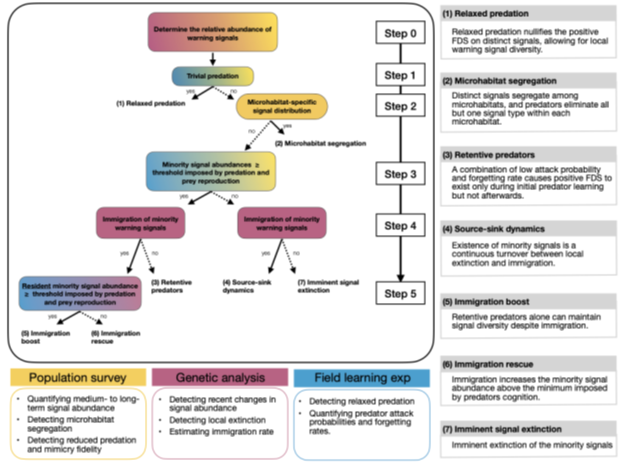
This study addresses this knowledge gap by summarizing seven potential resolutions—including relaxed predation, microhabitat segregation, retentive predators, source–sink dynamics, immigration boost, immigration rescue, and imminent signal extinction—and proposing an empirical, hierarchical hypothesis-testing framework. By integrating data from population surveys, genetic analyses, and field learning experiments, this framework provides a systematic pathway to evaluate the mechanisms maintaining local warning signal diversity. This work offers valuable insights into how ecological factors shape signal evolution and community dynamics in nature.